



Last updated: November 2, 2026
Short answer
To get your payments ready for this Black Friday (November 27th, 2026), put six things in order before the rush: current documents, product claims that match your application, your reserve and payout terms, your volume limits (plus a heads-up to your processor), a plan for disputes, and the name of the person to call if funds are held.
If you sell in a high-risk category, Black Friday is the day you’ve been building toward. It’s also the day your payment processor looks hardest at your account. This guide covers what to have in order before, during and after your biggest sales days.
Why does Black Friday get a closer look from processors?
To a processor, a record day looks like a sudden change. Volume jumps, the average order changes, new products show up and first-time buyers arrive from new places. Fraud produces the same patterns, so risk systems flag them.
There’s also money at stake for the processor. When a customer disputes a charge and the merchant can’t cover it, the processor and its bank absorb the loss. A spike in sales is a spike in future dispute exposure, which is why a review can come with a reserve or a hold on part of your payouts.
You can’t control how a processor’s risk model works. You can control how readable your business is before the volume shows up.
Key dates for Black Friday 2026
| Date | What happens | What it means for payments |
|---|---|---|
| Thu Nov 26 | Thanksgiving | Federal Reserve holiday. Bank transfers don’t settle, so payouts due that day move to the next business day. |
| Fri Nov 27 | Black Friday | Your highest-volume day, and the start of the dispute window for every order placed. |
| Sat Nov 28 | Small Business Saturday | Weekend: payouts usually wait for Monday. |
| Mon Nov 30 | Cyber Monday | Second peak. Payouts from the weekend start to land. |
| Fri Dec 11 | Federal hemp definition changes | For CBD and hemp sellers only. |
What should high-risk stores check before Black Friday?
These six checks apply to any high-risk store, but what to look for differs by category. For CBD, hemp, firearms. peptides and supplements, see what to check in your category before Black Friday.
1. Your documents are current
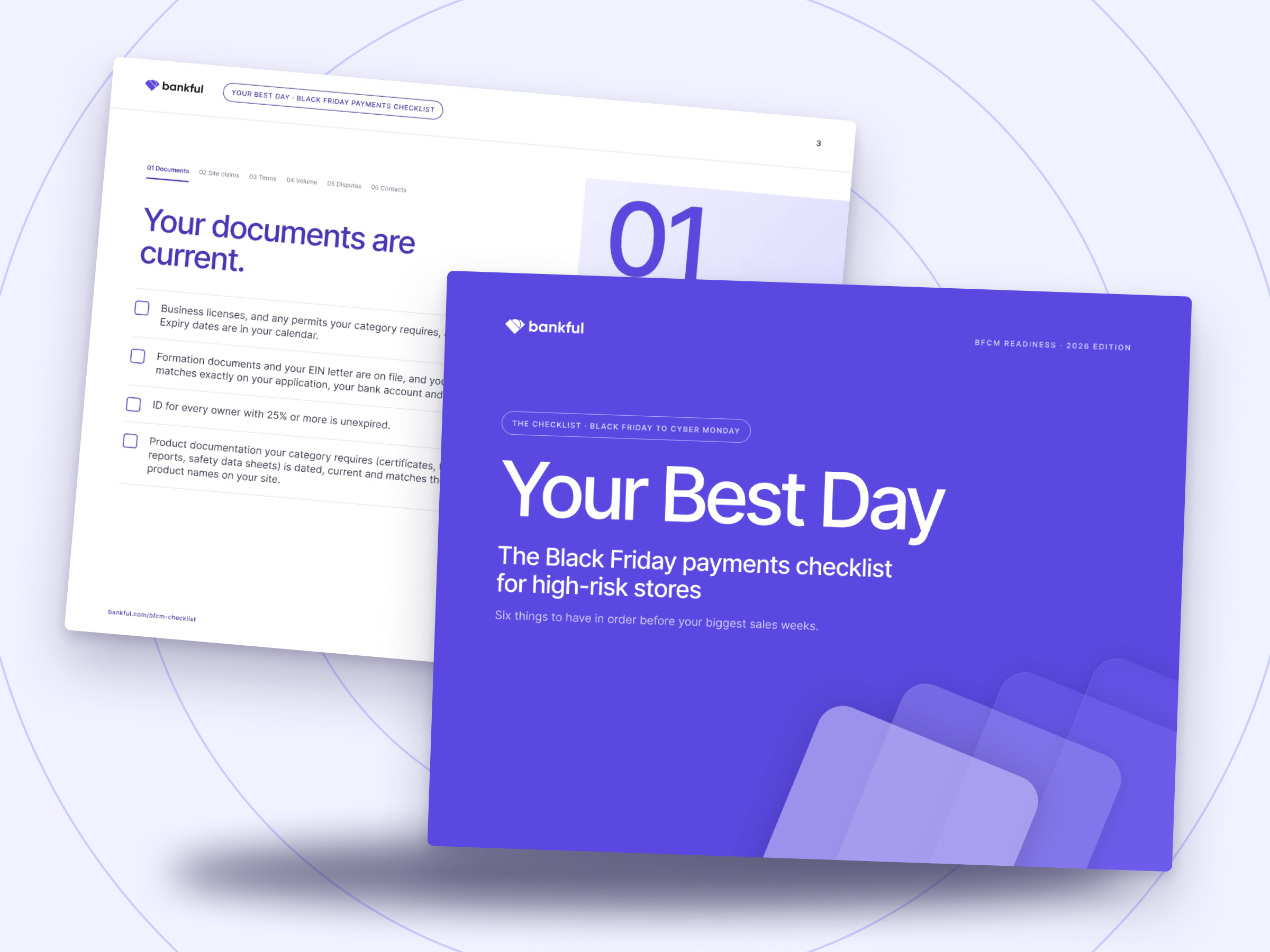
When a review starts, the first thing a processor asks for is paperwork. Check that business licenses and any permits your category requires are current, that your legal name matches exactly on your application, bank account and website, that ID for every owner with 25% or more is unexpired, and that product documentation (certificates, test reports, safety data sheets) matches the product names on your site.
2. Your site’s product claims match your application
Underwriters and card-brand site reviews compare what you said you sell with what your site sells and says. Holiday bundles and new product lines open a gap between the two. So do health, medical or performance claims added to a product page. Send new products to your processor before you list them, and keep your refund, shipping, privacy and terms pages easy to find.
3. You know your reserve, hold and payout terms
These terms decide how much of your holiday revenue reaches your bank account, and when. Find them in your merchant account agreement: whether you have a reserve and which kind, how much is held and for how long, your payout schedule, and what the agreement says can trigger a review.
4. You know your volume limits, and you tell your processor before a planned spike
Merchant accounts are usually approved for a monthly volume and a maximum transaction size. Going well past either without warning is one of the patterns that gets an account reviewed. Put your Black Friday forecast next to your limits. If you’ll go past them, tell your processor in writing before the promotion starts.
5. You have a plan for disputes and chargebacks during the peak
Peak season brings more shipping delays and more customers who don’t recognize a charge, so every dispute counts. Visa counts fraud reports and disputes together, and for US merchants with 1,500 or more a month, its threshold dropped to 1.5% in April 2026. Most processors set their own limit below that, so ask yours which number they watch and where you stand today. Then keep it low: save tracking for every order, keep your billing descriptor recognizable, turn on address and CVV checks, and refund before a customer has to dispute.
6. You know who to call when funds are held
Have the name, direct email and phone number of your processor’s risk or support contact, and their hours over Thanksgiving weekend. Keep one folder with what a review usually asks for: supplier invoices, tracking for recent orders, product documentation and your last three months of statements.
What should I send my processor before Black Friday?
A short email, sent before the promotion starts, gives your processor context before the numbers move. Include:
- The dates of your promotion.
- Expected volume over the period, next to your usual weekly volume.
- Expected average order, next to your usual one.
- What’s driving it: the sale, the email and ad push, a product launch.
- Any new products in the promotion, or “none”.
- A request to confirm it fits your current limits, in writing.
Keep the reply. It’s the most useful document you’ll have if your account gets a question later.
Why does Black Friday affect your account until March?
Under Visa’s rules, a customer generally has 120 days from the transaction, or from the expected delivery date, to file most disputes. Orders from November 27 can turn into disputes well into next year. Plan the peak, and plan the 120 days after it.
Where Bankful fits
Bankful is a high-risk payment processor. Our team knows high-risk categories, flag what to watch before it costs you, and go through your reserve, hold and payout terms with you before you sign.* Planning a big sale? Tell us first and we’ll help you get set up.
Free checklist (PDF)
Download the free checklist
Get the Your Best Day checklist: the six checks above as a PDF you can work through with your team.
Frequently asked questions
Why can a big sales day trigger a review or a hold?
Sudden jumps in volume, order size and new products look like fraud patterns to risk systems, and they raise the processor’s exposure to future disputes. A review can come with a reserve or a payout hold until it’s resolved.
Should I tell my processor before Black Friday?
Yes, if you expect to go past your usual volume or your limits. Send the dates, the volume and average order you expect, and what’s driving it, and ask for a reply in writing.
Does Thanksgiving delay payouts?
Thanksgiving (November 26, 2026) is a Federal Reserve holiday, so bank transfers don’t settle that day. Check your payout schedule for the holiday week.
What’s a reserve?
Money a processor holds back from payouts to cover future refunds and chargebacks. It can be a rolling percentage, a fixed amount or an up-front deposit. Your merchant account agreement says which applies.
How long after Black Friday can customers dispute a charge?
For most Visa disputes, 120 days from the transaction or the expected delivery date.
This article is general guidance, not legal advice. Your processor’s agreement and acceptable use policy, and the laws of the states you sell to, govern your business.
*Bankful is a payment processor and, in some arrangements, provides software and orchestration services under the Bankful Software Agreement. As described in that agreement (§5.11), merchant account services are governed by a separate agreement with the applicable processor of record. Depending on the arrangement, Bankful may be the direct processor of record or may orchestrate routing to a third-party processor. Eligibility to process, including approval, continued processing, holds, freezes, and account termination, is determined at underwriting by the processor of record under its own terms, which vary by provider and may change. Merchants are responsible for understanding and complying with the governing terms of service and acceptable use policy. Merchant onboarding also includes a Hold Harmless agreement under which the merchant acknowledges how responsibility for processing decisions is allocated.