


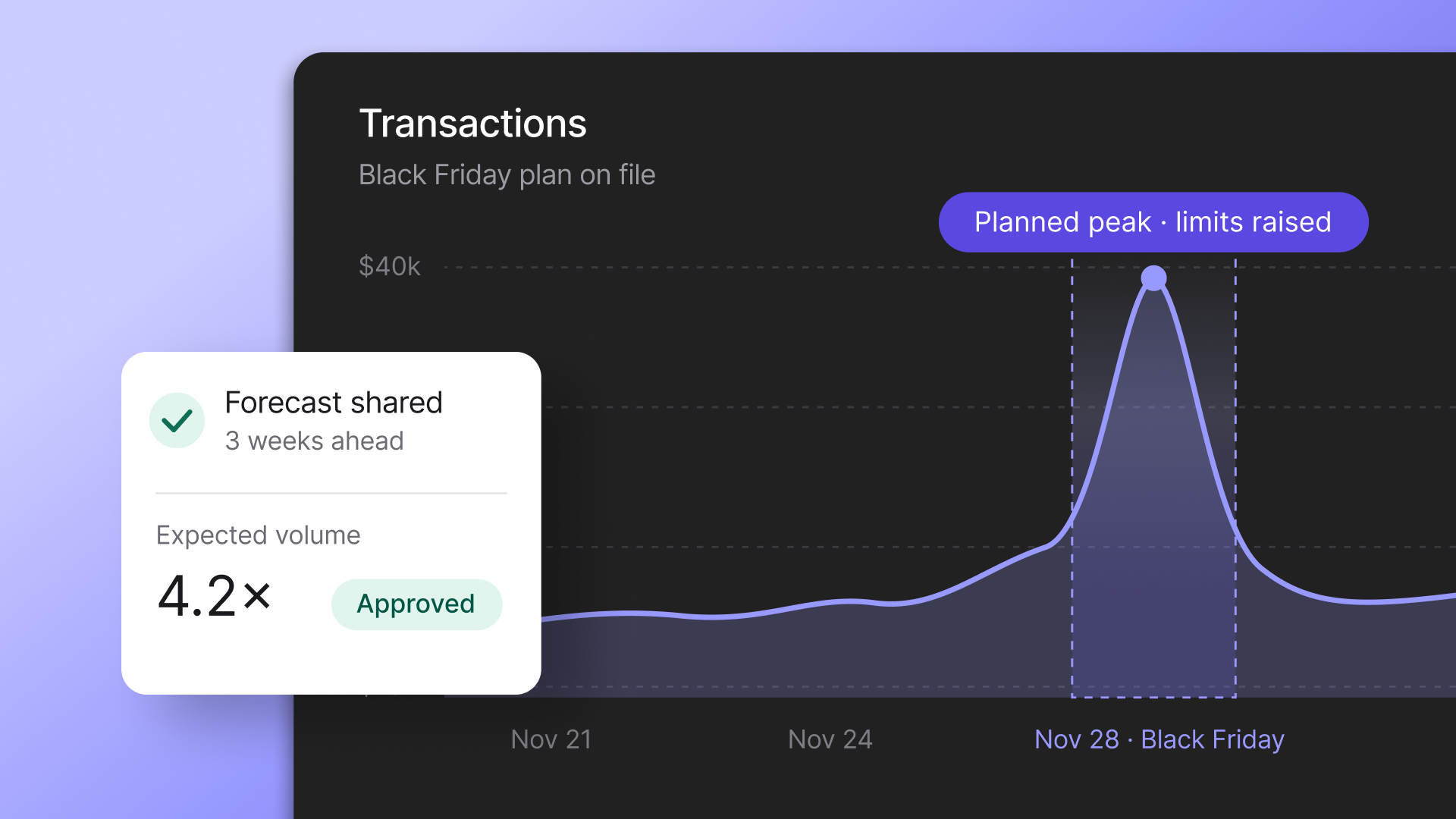
Before the rush
Plan your biggest sales day with your processor
To a processor that doesn’t know your category, a record sales day can look like a risk event. Volume jumps, the average order changes, a new product shows up, and the account goes to review.
Your Best Day Checklist
Six things to put in order before your next peak sales period.
Documents
Your documents are current: licenses, lab reports or COAs, formation papers.
Claims
Your website’s product claims match your application.
Terms
You know your reserve, hold and payout terms.
Volume
You know your volume limits, and you tell your processor before a planned spike.
Disputes
You have a plan for disputes and chargebacks during the peak.
Contacts
You know who to call when funds are held.
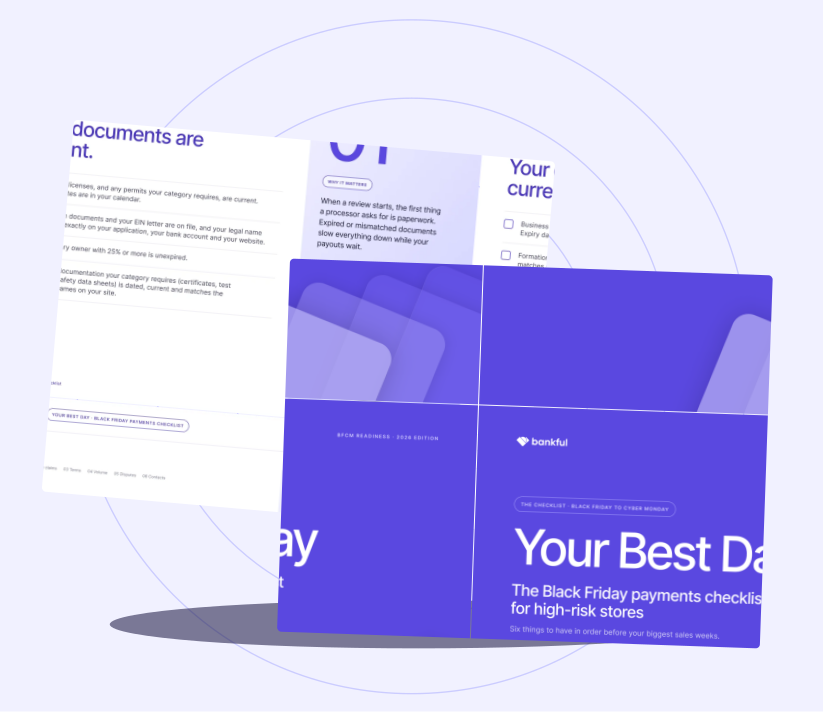
Get the free checklist
A practical PDF you can share with your team.
Category readiness
What to check in your category
CBD & hemp
What changes at peak
- If you run Black Friday deals, volume, order size and first-time buyers all jump in the same few days.
- Holiday bundles and gift sets add SKUs that weren’t on your application.
- Gift orders ship to addresses, and states, you don’t usually ship to.
- The federal hemp definition changes on December 11, two weeks after Cyber Monday. It counts total THC, including THCA and delta-8, and caps finished products at 0.4 mg total THC per container. Clearing affected stock before then means a volume spike in exactly the products the underwriters read most closely.†
What an underwriter looks at
- COAs from a third-party lab, matched to each SKU and batch, showing THC content.
- Product claims. Anything that reads as treating, curing or preventing a condition is what FDA warning letters target.
- Your product types (topicals, tinctures, edibles, smokables, THCA), listed the way they appear on your site.
- An age gate and state shipping rules that work at checkout.
- Subscription terms and how easy it is to cancel.
- Your dispute and refund history.
Before your peak
- Pull a COA for every SKU in your holiday catalog, bundles included. Check that batch numbers and product names match the site.
- Send new SKUs, bundles or product types to your processor before you list them.
- Check every product page, email and ad for health claims.
- Test checkout with addresses in states you don’t ship to.
- Go through your catalog for products affected on December 11 and decide what happens to them before you discount them.†
- Put your auto-ship terms and cancel link where holiday sign-ups will see them.
Disputes to expect, and how to answer them
- Item not received (Visa 13.1): holiday shipping delays and wrong addresses. Answer with tracking that shows delivery to the address on the order.
- Not as described (13.3): answer with the product page as it read on the order date, the COA for that batch and your refund policy.
- Cancelled recurring (13.2): holiday buyers who forget they signed up for auto-ship. Answer with the terms they accepted, the renewal reminder you sent and your cancellation records.
- Fraud and unrecognized charges (10.4): answer with AVS and CVV results, the customer’s order history and proof of delivery.
Visa counts fraud reports and disputes together. Its US monitoring threshold dropped from 2.2% to 1.5% in April 2026. A refund issued before the customer disputes never becomes a dispute.
Questions to ask your processor, in writing
- Which of my product types are approved on my account?
- Do you need a COA before I list a new SKU or bundle?
- What’s my monthly volume limit, and how do I request an increase before Black Friday?
- What’s my reserve, and does it change when my volume does?
- What happens to my account and listings for products affected by the December 11 changes?†
- What dispute and fraud ratio do you watch, and what do you need from me if I get close?
- If funds are held, who do I contact and what documents will you ask for?
Firearms & ammo
What changes at peak
- Black Friday has repeatedly set single-day records for FBI background checks, so your record day lands on the industry’s.
- Ammo orders get bigger, and high-ticket orders draw card testing and stolen cards.
- Gift buyers order firearms without knowing the transfer rules, and some FFLs close or slow down over the holiday weekend.
- Popular calibers and models sell out, and backorders turn into disputes.
What an underwriter looks at
- Your FFL, plus your SOT if you sell NFA items: current, matching your business name and on file.
- That firearms ship to an FFL in the buyer’s state, with the transfer step built into checkout.
- Age checks on ammunition at checkout. As a licensee that means 18 for long-gun ammo and 21 for handgun ammo.†
- State restrictions on ammo and magazines, enforced at checkout, not just listed.
- Your catalog checked item by item against your processor’s acceptable use policy, parts and accessories included.
- Your refund policy for denied or cancelled transfers.
- Your dispute history and billing descriptor.
Before your peak
- Check your FFL and state license expiry dates, and send renewals to your processor before they lapse.
- Test checkout with addresses in your most restricted states.
- Publish your transfer, denial and restocking policy where buyers accept it at checkout.
- Turn on AVS, CVV and 3-D Secure, and set ammo order limits for new customers.
- Mark backordered items clearly, and email buyers a date before they ask.
- Send your processor your Black Friday forecast, including the average order you expect.
Disputes to expect, and how to answer them
- Item not received (13.1): a firearm sitting at an FFL the buyer hasn’t visited, or ammo held by the carrier. Answer with carrier proof of delivery to the FFL, signature delivery where you used it, and the FFL’s transfer record.
- Denied transfer: the buyer fails the background check and disputes before the refund lands. Answer with your published denial policy, the refund date and the refund record.
- Not as described (13.3): wrong caliber, model or finish. Answer with the product page as it read on the order date and your packing record.
- Fraud (10.4): stolen cards on big orders. Answer with AVS and CVV results, 3-D Secure authentication, IP and device data, and order history.
The same 1.5% Visa threshold applies.
Questions to ask your processor, in writing
- Which product lines are approved on my account: firearms, ammunition, NFA items, parts, accessories?
- What do you need on file for my FFL and SOT, and when they renew?
- Which merchant category code is my account registered under?
- What’s my monthly volume limit, and how do I raise it before Black Friday?
- What’s my reserve, and does it change when my volume does?
- What dispute and fraud ratio do you watch, and what do you need from me if I get close?
- If funds are held, who do I contact and what will you ask for?
Peptides & supplements
What changes at peak
- Stacks, bundles and multi-vial deals add SKUs and order sizes that weren’t on your application.
- Discounted first months on auto-ship bring in subscribers whose first full-price renewal lands in January.
- Large first orders from new customers draw card testing and stolen cards.
- Peptide rules are still moving. In July, an FDA advisory committee recommended adding BPC-157, TB-500, MOTS-c, KPV, Epitalon and Semax to the list of substances pharmacies can compound from. Those votes aren’t final until FDA finishes rulemaking, which could run into 2027 or later, so a holiday push on those products lands while their status is still open.†
What an underwriter looks at
- The route each product is sold under: an FDA-approved drug, a compounded drug made for a patient with a prescription, a dietary supplement or a research chemical. Every SKU should fit one, and your site should say what your application says.
- For prescription products, a prescriber or telehealth step built into checkout, and a pharmacy licensed in every state you ship to.
- Certification where your model calls for it, such as LegitScript Healthcare Merchant Certification for prescription products.
- “Research use only” or “not for human consumption” labels next to dosing guides, before-and-after photos or a consumer checkout. That mismatch is one of the first things a reviewer flags.
- Product claims, affiliate and influencer posts included. Anything that reads as treating, curing or preventing a condition, or that compares a compounded product to a brand-name drug, is what FDA warning letters target.†
- Third-party purity testing (COAs) matched to each SKU and batch.
- Subscription terms, how easy it is to cancel, and your dispute and refund history.
Before your peak
- List every SKU in your holiday catalog, stacks and bundles included, next to the route it’s sold under. Fix or pull anything whose label and marketing don’t match.
- Send new SKUs, stacks or bundles to your processor before you list them.
- Check every product page, email, ad and affiliate post for health claims and brand-name comparisons.
- Pull a current COA for every SKU and batch. Check that batch numbers and product names match the site.
- Test checkout end to end: the prescription step, any age gate and the states you don’t ship to.
- Put your auto-ship terms, renewal date and cancel link where holiday sign-ups will see them, and send a reminder before the first full-price renewal.
Disputes to expect, and how to answer them
- Cancelled recurring (Visa 13.2): a discounted first month renews at full price in January. Answer with the terms they accepted, the renewal reminder you sent and your cancellation records.
- Not as described (13.3): “it didn’t work,” or a purity complaint. Answer with the product page as it read on the order date, the COA for that batch and your refund policy. A page that never promised a result is the easiest one to defend.
- Item not received (13.1): holiday shipping delays and packages held by the carrier. Answer with tracking that shows delivery to the address on the order.
- Fraud and unrecognized charges (10.4): stolen cards on large first orders, and a billing descriptor the customer doesn’t recognize. Answer with AVS and CVV results, 3-D Secure authentication, order history and proof of delivery.
The same 1.5% Visa threshold applies. A subscription dispute usually arrives when the first renewal posts, weeks after the sale.
Questions to ask your processor, in writing
- Which of my product types are approved on my account, and do you need to see a new SKU or stack before I list it?
- Do any of my products need a certification, such as LegitScript, and what happens if I don’t have it?
- Which merchant category code is my account registered under?
- What’s my monthly volume limit, and how do I request an increase before Black Friday?
- What’s my reserve, and does it change when my volume does?
- If FDA changes the status of a peptide I sell, what happens to my account and those listings?†
- What dispute and fraud ratio do you watch, and what do you need from me if I get close?
- If funds are held, who do I contact and what documents will you ask for?
†This is general guidance, not legal advice. Your processor’s agreement, its acceptable use policy and the laws of the states you sell to govern your business.
A specialist in your corner
High-risk payment processing, run by people who know your industry
- We fight for your approval*
- Underwriters who know CBD, hemp, firearms and ammo
- We flag what to watch before it costs you
- Planning a big sale? Tell us first and we’ll go through it with you
- Same team every call

Every way to get paid.
One partner.
Cards, ACH, digital wallets and subscriptions in one checkout.
Hosted or native checkout, matched to your platform.
The Vault saves returning customers’ details for faster repeat checkout.
Fraud and chargeback tools built in.
Questions merchants ask
How do I get my payments ready for Black Friday?
Why can a big sales day trigger a review or a hold?
Should I tell my processor before Black Friday?
What’s a reserve?
Plan your best day with us.
Tell us about your peak. A payment specialist will tell you straight what we can do.
How approvals work**Bankful is a payment processor and, in some arrangements, provides software and orchestration services under the Bankful Software Agreement. As described in that agreement (§5.11), merchant account services are governed by a separate agreement with the applicable processor of record. Depending on the arrangement, Bankful may be the direct processor of record or may orchestrate routing to a third-party processor. Eligibility to process, including approval, continued processing, holds, freezes, and account termination, is determined at underwriting by the processor of record under its own terms, which vary by provider and may change. Merchants are responsible for understanding and complying with the governing terms of service and acceptable use policy. Merchant onboarding also includes a Hold Harmless agreement under which the merchant acknowledges how responsibility for processing decisions is allocated.