



Last updated: November 10, 2026
Short answer
Black Friday is one of the busiest days of the year for FBI firearm background checks, so firearms and ammo sellers see their heaviest volume and their closest payment review on the same day. Before the rush, confirm your FFL and state licenses are on file with your processor, enforce age and state rules at checkout, publish your transfer and denial policy, and send your processor your forecast.
Why is Black Friday different for firearms and ammo sellers?
Black Friday regularly lands on the FBI’s list of the busiest days for firearm background checks. Black Friday 2023 is the third-highest day on record, with 214,913 checks, and Black Fridays in 2017 and 2019 also made the top 10. For a licensed seller, the busiest day of the year is also the day orders, transfers and shipping rules all get tested at once.
What changes at peak:
- Ammo orders get bigger, and big orders draw card testing and stolen cards.
- Gift buyers order firearms without knowing the transfer rules.
- Some FFLs close or slow down over the holiday weekend.
- Popular calibers and models sell out, and backorders turn into disputes.
How do online firearm sales work at checkout?
Under federal law, a licensed dealer generally can’t sell a firearm to an unlicensed buyer who lives in another state unless the firearm ships to a licensee in the buyer’s state, where the buyer takes delivery. In practice, online firearm orders ship to an FFL near the buyer, who completes the transfer paperwork and background check before handing it over.
In May 2026, the ATF proposed a rule that would let licensed dealers complete in-state sales without the buyer appearing in person, using remote identity checks and electronic notice to local law enforcement. News coverage describes it as opening the door to delivery at the buyer’s home. It is a proposal, not a rule: comments closed August 6, 2026, and no final rule had been published as of November 4, 2026.
For your checkout and your processor, that means:
- The transfer step is built into checkout: the buyer picks a receiving FFL before paying.
- Your transfer, denial and restocking policy is published and accepted at checkout.
- Your refund process for denied transfers is written down and fast.
What rules affect ammunition checkout and shipping?
- Age. A licensee can sell rifle or shotgun ammunition to buyers 18 or older, and handgun ammunition only to buyers 21 or older.
- State rules. Some states add background checks or licensed-vendor requirements for ammunition, and some restrict magazine capacity. Your checkout should block what each state restricts, not just list it.
- Shipping. Ammunition can’t be mailed through USPS. Private carriers ship firearms only for licensed shippers with a carrier agreement, and require adult signature on firearm deliveries.
What does an underwriter look at for a firearms or ammo store?
- Your FFL, and your SOT if you deal in NFA items: current, matching your business name, on file.
- How firearms ship: to an FFL in the buyer’s state, with the transfer step in checkout.
- Age checks and state restrictions enforced at checkout.
- Your catalog, item by item, against your processor’s acceptable use policy, parts and accessories included.
- Your refund policy for denied or cancelled transfers.
- Your dispute history and billing descriptor.
NFA items are a moving target this season. Following an August 2026 federal court ruling, the ATF said it won’t enforce NFA registration or tax-stamp requirements for suppressors, short-barreled rifles and shotguns, and AOWs. That’s an enforcement policy, not a change in the law. It can be reversed, and state laws still apply. If you plan to promote these items at peak, ask your processor in writing whether they’re approved on your account first.
What disputes should I expect, and how do I answer them?
| Dispute | Common cause at peak | Evidence that answers it |
|---|---|---|
| Item not received (Visa 13.1) | Firearm waiting at an FFL the buyer hasn’t visited; ammo held by the carrier. | Carrier proof of delivery to the FFL, signature records, the FFL’s transfer record. |
| Credit not processed (Visa 13.6) | Buyer fails the background check and disputes before the refund lands. | Your published denial policy, the refund date and the refund record. |
| Not as described (Visa 13.3) | Wrong caliber, model or finish. | The product page as it read on the order date, and your packing record. |
| Fraud (Visa 10.4) | Stolen cards on large ammo orders. | Address and CVV results, 3-D Secure authentication, IP and device data, order history. |
Visa counts fraud reports and disputes together, and its US merchant threshold dropped to 1.5% in April 2026.
Before your peak: the short list
- Check your FFL and state license expiry dates, and send renewals to your processor before they lapse.
- Test checkout with addresses in your most restricted states.
- Publish your transfer, denial and restocking policy where buyers accept it.
- Turn on address and CVV checks and 3-D Secure, and set ammo order limits for new customers.
- Mark backorders clearly and email buyers a date before they ask.
- Send your processor your Black Friday forecast, including the average order you expect.
What should I ask my processor, in writing?
- Which product lines are approved on my account: firearms, ammunition, NFA items, parts, accessories?
- What do you need on file for my FFL and SOT, and when they renew?
- Which merchant category code is my account registered under?
- What’s my monthly volume limit, and how do I raise it before Black Friday?
- What’s my reserve, and does it change when my volume does?
- If funds are held, who do I contact and what will you ask for?
The merchant category code question matters more than it used to: a firearms-specific code (MCC 5723) exists, and states have passed laws both requiring and prohibiting its use.
Where Bankful fits
Bankful is a high-risk payment processor, and our underwriters know firearms and ammo businesses.* If you want a second read on your setup before Black Friday, talk to a payments specialist.
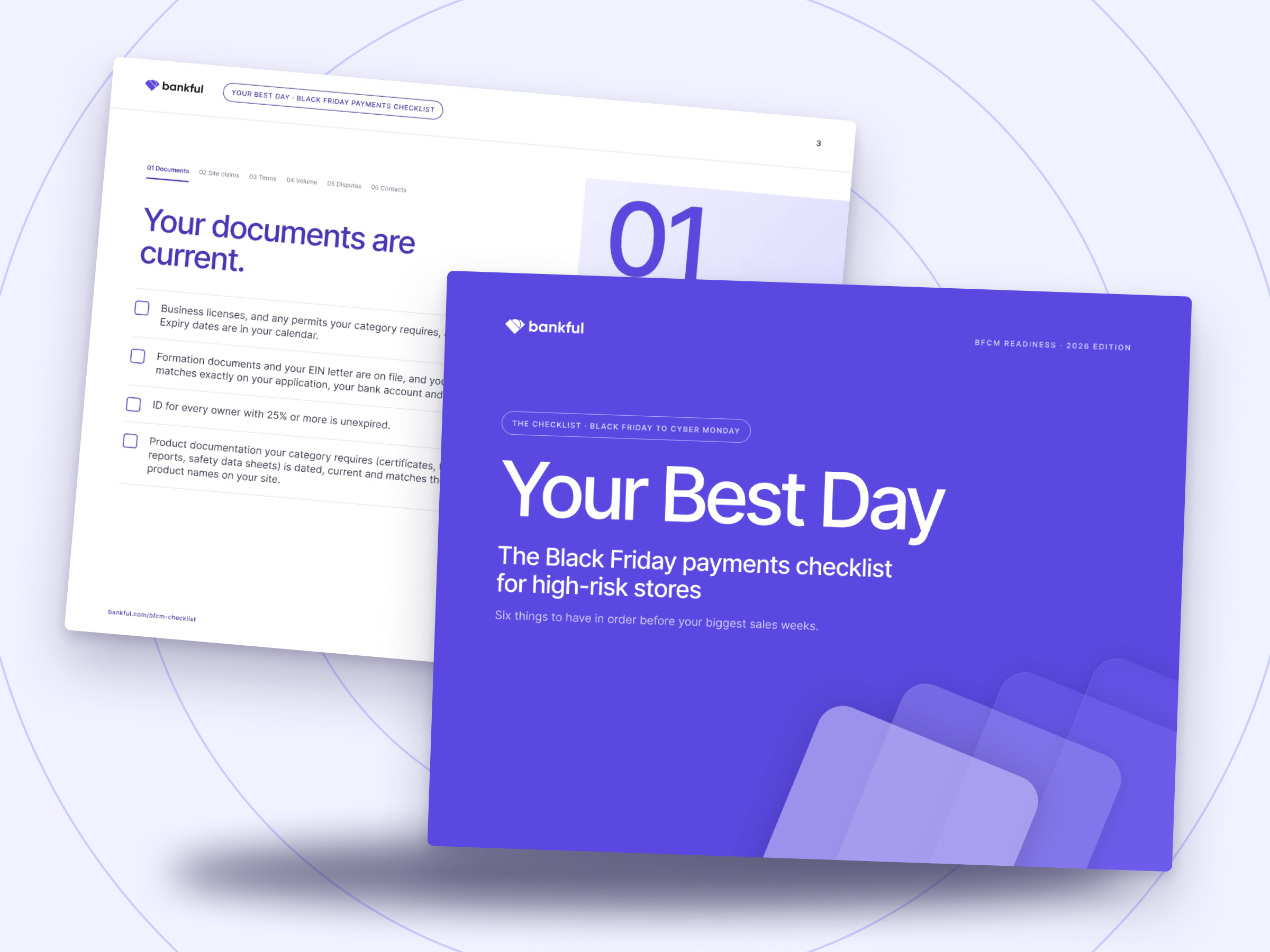
Free checklist (PDF)
Get the Your Best Day checklist
Six checks for your biggest sales day, as a PDF you can work through with your team.
Frequently asked questions
Can I ship a firearm directly to a customer’s home?
Not under current federal rules for most online sales: the firearm ships to a licensee in the buyer’s state, who completes the transfer. A May 2026 ATF proposal would allow some in-state sales without the buyer appearing in person, but it isn’t final.
Can I ship ammunition through USPS?
No. Small arms ammunition is classified as hazardous material and can’t be mailed. Use a private carrier and follow its hazardous-materials rules.
How old does a buyer have to be to buy ammunition?
From a licensee, 18 for rifle or shotgun ammunition and 21 for handgun ammunition. Some states set stricter rules.
What’s a common Black Friday dispute for firearms sellers?
Item not received, often a firearm waiting at an FFL the buyer hasn’t visited yet. Proof of delivery to the FFL answers it.
This article is general guidance, not legal advice. Your processor’s agreement and acceptable use policy, and the laws of the states you sell to, govern your business.
*Bankful is a payment processor and, in some arrangements, provides software and orchestration services under the Bankful Software Agreement. As described in that agreement (§5.11), merchant account services are governed by a separate agreement with the applicable processor of record. Depending on the arrangement, Bankful may be the direct processor of record or may orchestrate routing to a third-party processor. Eligibility to process, including approval, continued processing, holds, freezes, and account termination, is determined at underwriting by the processor of record under its own terms, which vary by provider and may change. Merchants are responsible for understanding and complying with the governing terms of service and acceptable use policy. Merchant onboarding also includes a Hold Harmless agreement under which the merchant acknowledges how responsibility for processing decisions is allocated.