



Last updated: November 5, 2026
Short answer
When a sales spike triggers a review, a processor can delay payouts, hold part of each sale in a reserve, or pause payouts while it checks the business. The money is set aside to cover future refunds and chargebacks. How much is held, for how long and what releases it are set by your merchant account agreement.
A hold right after your best sales day feels personal. It usually isn’t. It’s a risk system reacting to a pattern, and most of what happens next depends on how fast and how completely you answer. Here’s how holds work and what to do.
Why does a sales spike trigger a hold?
Processors and their banks carry the risk of your future disputes. If customers dispute charges and the merchant can’t pay them back, the processor covers the loss. Bank regulators expect processors to hold reserves against that risk, especially for higher-risk merchants. A sudden spike raises that exposure overnight, especially when:
- Volume goes past the monthly limit your account was approved for.
- The average order is much higher than usual.
- Products appear that weren’t on your application.
- Refunds, disputes or fraud reports rise at the same time.
- Orders won’t ship for weeks, so the processor carries the risk longer.
What kinds of holds are there?
| Type | How it works | What to ask |
|---|---|---|
| Payout delay | Payouts slow down (for example, from daily to weekly) while the account is reviewed. | When does the normal schedule resume? |
| Rolling reserve | A percentage of each sale is held for a set period, then released on a rolling basis. Industry guides put it at about 5% to 15% of each sale, held for 90 days to six months or longer. | What percentage, for how long, and what would lower it? |
| Fixed reserve | A set amount is held until a condition is met, such as a period of clean processing. | What condition releases it? |
| Up-front reserve | A lump sum is held before or during processing, often sized to expected volume. | Is it refundable, and when? |
| Full hold or freeze | All payouts pause while the processor reviews the account. | What exactly do you need from me to finish the review? |
Card networks give customers up to 120 days to file most disputes, which is why reserves are often held for months, not weeks.
What happens during a review?
Reviews follow a similar shape across processors: a notice that payouts are held or delayed, a request for documents, a review of what you send, and a decision. The decision can be a release, a reserve, new volume limits, or in some cases closing the account. How long it takes depends on the processor and on how quickly complete documents come back.
What will they ask for?
- Supplier invoices that show you own the inventory you’re selling.
- Tracking and delivery confirmation for recent orders.
- An explanation of the spike: the promotion, the dates, the channels.
- Product documentation for what you sold.
- Recent bank and processing statements.
- Your refund, shipping and terms pages.
What should I do in the first 48 hours?
- Read the notice twice. Note exactly what’s held and what’s being asked for.
- Reply in writing. Ask four questions: what triggered the review, what documents they need, what’s held and on what schedule it’s released, and whether future payouts are affected.
- Send everything once, complete and labeled. Piecemeal answers mean more rounds of questions.
- Keep fulfilling orders and answering customers. Cancelled orders and silence turn into disputes, and disputes make the review harder.
- Refund promptly when customers ask. A refund issued before a dispute keeps it off your dispute count.
- Don’t route sales through another account. Processing through a second account or someone else’s breaks most merchant agreements and card network rules.
Can a processor keep my money?
Held funds are set aside against refunds, disputes and fees you may owe. When the hold period ends, what’s left is released under the terms of your agreement. If an account closes, reserves are usually held through the dispute window, which can run up to 180 days, before the balance is paid out. If you disagree with how funds are being handled, your merchant account agreement is the document that decides it, and a lawyer is the right person to read it with you.
How do I lower the chance of a hold next time?
Make your business easy to read before the volume shows up: documents current, product claims matching your application, your limits known, and your processor told about the promotion in writing. Our Black Friday payments checklist walks through all six checks.
If you’re choosing your next processor, ask these questions about reserves and payouts before you sign.
Where Bankful fits
Bankful is a high-risk payment processor. Our team knows high-risk categories, flag what to watch before it costs you, and go through your reserve, hold and payout terms with you before you sign.* Planning a big sale? Tell us first and we’ll help you get set up.
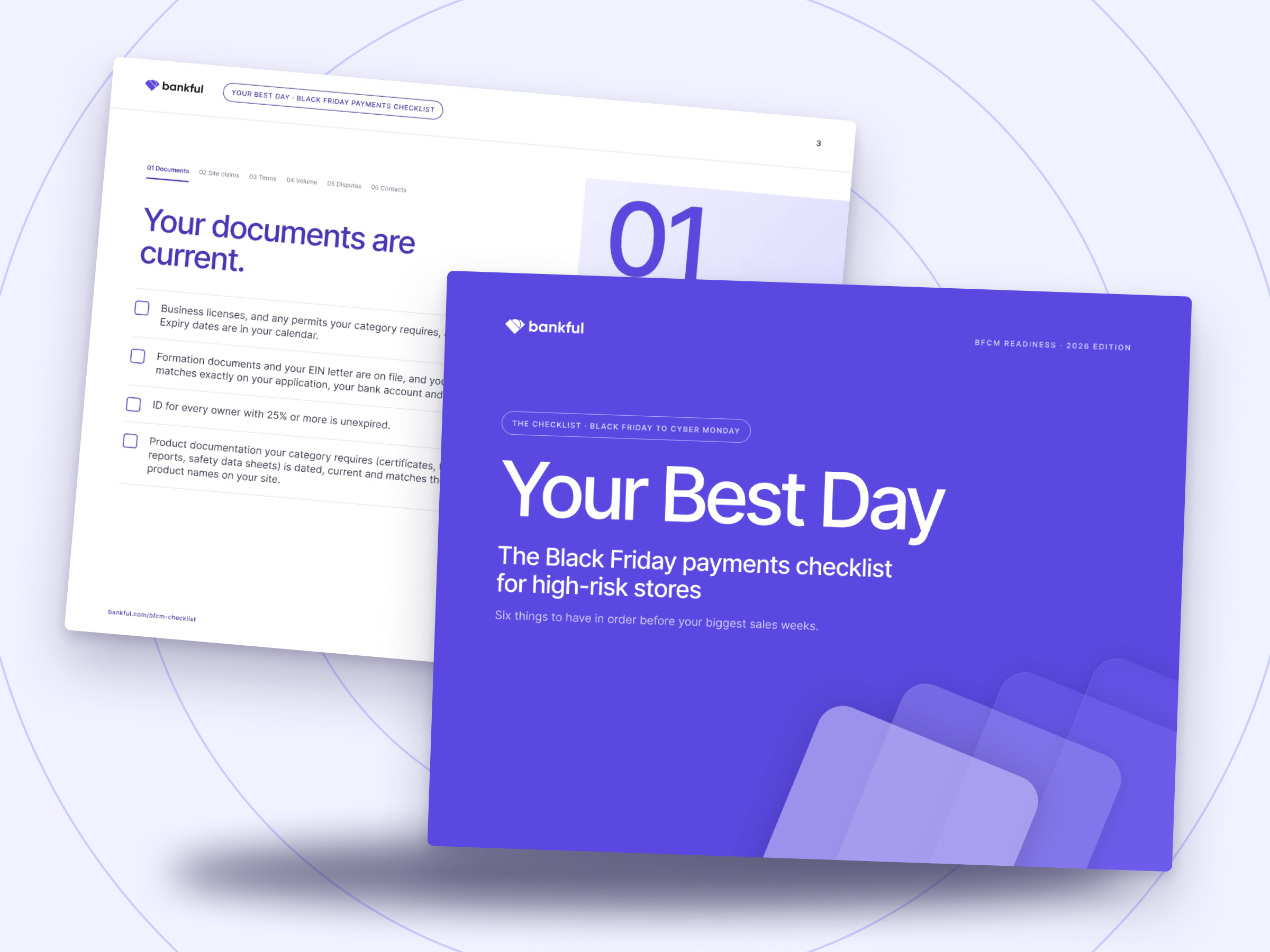
Free checklist (PDF)
Download the free checklist
Get the Your Best Day checklist: the six checks above as a PDF you can work through with your team.
Frequently asked questions
Is a hold the same as a reserve?
No. A hold pauses or delays payouts while an account is reviewed. A reserve is an ongoing amount or percentage held back against future refunds and disputes. A review can end with either, both or neither.
How long can a processor hold funds?
A review hold usually lasts until you’ve sent the documents the processor asks for. A rolling reserve typically holds 5% to 15% of each sale for 90 days to six months. The long window exists because most card disputes can be filed up to 120 days after a transaction. Your merchant account agreement sets the actual terms.
What is a rolling reserve?
A percentage of each sale held for a set period and released on a rolling basis, so funds from older sales come back as new ones are held.
How do I get held funds released?
Send complete documents in one reply, keep fulfilling orders, refund customers who ask, and get the release conditions from your processor in writing.
Will a hold affect my future payouts?
It can, if the review ends with a reserve or a slower payout schedule. Ask your processor in writing.
This article is general guidance, not legal advice. Your processor’s agreement and acceptable use policy, and the laws of the states you sell to, govern your business.
*Bankful is a payment processor and, in some arrangements, provides software and orchestration services under the Bankful Software Agreement. As described in that agreement (§5.11), merchant account services are governed by a separate agreement with the applicable processor of record. Depending on the arrangement, Bankful may be the direct processor of record or may orchestrate routing to a third-party processor. Eligibility to process, including approval, continued processing, holds, freezes, and account termination, is determined at underwriting by the processor of record under its own terms, which vary by provider and may change. Merchants are responsible for understanding and complying with the governing terms of service and acceptable use policy. Merchant onboarding also includes a Hold Harmless agreement under which the merchant acknowledges how responsibility for processing decisions is allocated.